Home

AC103-6

AC103-7

AC20-27F

Accident Reporting

AIM

Administration

AeroMedical

Aeronautical Decision Making (ADM)

Airport Facility Directory

Airport Security

Airport Markings

Airport Operations

Airspace

Airworthiness Certification

Annual Inspection

ASTM

 Board Members

Canopy

Congested Areas

Contact NAPPF

Currency

Density Altitude

Endorsements

Flight Parks

Flight Instruction

Flight Instruments

Flight Review

Flight Plan

Formation Flying

Fuel Management

Hints


History

Home

Insurance

Knowledge Test

LINKS

Light Sport Aircraft Process

Light Sport Aircraft Repairman

Logbooks

NAPPF UPDATE


Navigation

News

NOTAM

NPRM

Pilot Privileges & Limitations

Pilot/Instructor Requirements

Part 103

Part 103 Preamble

Part 103 Waivers

Radio

Resources

Safety Seminars

Sectional Charts

Soft Field Operations

Sport Pilot Topics

TFR

Training

Training Materials

UltraFlight Magazine

UltraFlight Radio

Visibility & Cloud Clearance

Visual Approach Slope Indicator (VASI)

Weather

Weather Services

Home
 

NAPPF
Visibility & Cloud Clearance

Jim Sweeney, NAPPF President and USUA Board Member
"Visibility Requirements for Ultralights". The ability to see and be seen while flying is basic to safety. Jim Sweeney walks us through the visibility rules laid out by the FAA for ultralight aircraft. (Part 1) (12/2/03)

Listen Now!

Jim Sweeney, NAPPF President and USUA Board Member
"Visibility Requirements for Ultralights". The ability to see and be seen while flying is basic to safety. Jim Sweeney walks us through the visibility rules laid out by the FAA for ultralight aircraft. (Part 2) (12/2/03)

Listen Now!

Text & Graphics for Sound Clip

Sec. 103.11 - Daylight operations.

(a) No person may operate an ultralight vehicle except between the hours of sunrise and sunset.

(b) Notwithstanding paragraph (a) of this section, ultralight vehicles may be operated during the twilight periods 30 minutes before official sunrise and 30 minutes after official sunset or, in Alaska, during the period of civil twilight as defined in the Air Almanac, if:

(1) The vehicle is equipped with an operating anticollision light visible for at least 3 statute miles; and

(2) All operations are conducted in uncontrolled airspace.

Sec. 103.21 Visual reference with the surface

No person may operate an ultralight vehicle except by visual reference with the surface.

Sec. 103.23 Flight visibility and cloud clearance requirements

No person may operate an ultralight vehicle when the flight visibility or distance from clouds is less than that in the table found below. All operations in Class A, Class B, Class C, and Class D airspace or Class E airspace designated as an airport must receive prior ATC authorization as required in 103.17 of this part.

Airspace Flight Visibility Distance from Clouds
Class A Not applicable Not applicable
Class B 3 Statute Miles Clear of Clouds
Class C 3 Statute Miles 500 feet below
1,000 feet above
2,000 feet horizontal
 
Class D 3 Statute Miles 500 feet below
1,000 feet above
2,000 feet horizontal
 
Class E    
Less than 10,000 feet MSL
3 statute miles
 
500 feet below
1,000 feet above
2,000 feet horizontal
At or Above 10,000 feet MSL
5 statute miles
 
1,000 feet below
1,000 feet above
1 statute mile horizontal
Class G    
1200 feet or less above the surface
(regardless of MSL altitude)
1 Statute Mile Clear of Clouds
More than 1200 feet above the surface,
but less than 10,000 feet MSL
1 Statute Mile 500 feet below
1,000 feet above
2,000 feet horizontal
 
More than 1200 feet above the surface
and at or above 10,000 feet MSL
5 Statute Miles 1,000 feet below
1,000 feet above
1 statute mile horizontal


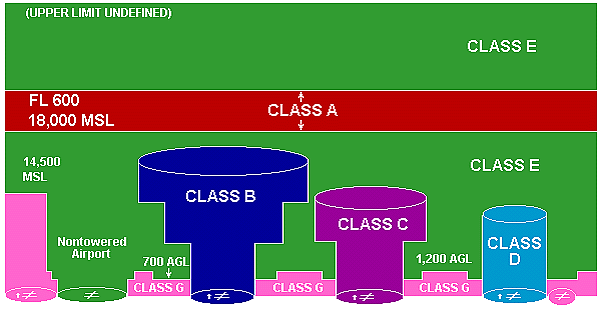
Airspace Classification at a Glance


MSL - Mean Sea Level
AGL - Above Ground Level
FL- Flight Level
 

Send mail to info@nappf.com with questions or comments about this web site.
Copyright © 2001 North American Powered Parachute Federation
Last modified: 03/26/07